Saturday, April 28, 2018

Delacroix's Doodles

Bill and I found so much to like at the Louvre's Delacroix show.
 We were both drawn to the lithographs of this master printmaker. Here are three from 1827 -- Mephistopheles in the air,
Faust and Mephistopheles in the Mountains of Harz (note the marginal drawings),
and Mephistopheles introduces himself to Marthe. 

*     *     *

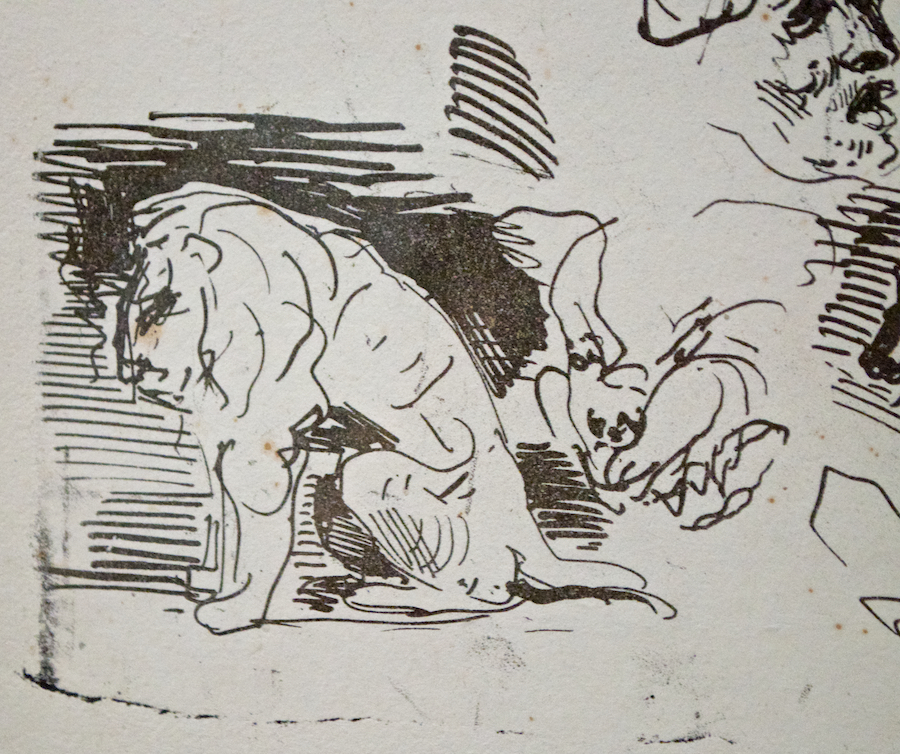
About those marginal drawings. The wall text tells us this is the first state of the print. It is fun to think of Delacroix so full of invention that he couldn't resist filling in the margins of the stone for the test versions of the print. 
 Here is closer look at some of these quick sketches.
 Love these tigers in repose.
Among the faces.
 And this grumpy lion.
Proves Delacroix just could not make an uninteresting line.

Wednesday, April 25, 2018

Birthday Lunch at Le Bougnat

Monday was my birthday so John took me to Le Bougnat for lunch. It is one of my favourite restaurants in Paris.
We were disappointed to find it closed but that did give me a chance to take this shot of the image on their shutter. By the way, a bougnat is a coal merchant.
When we went back the next day the brasserie had just opened.
The dining room was empty. It soon filled up.
Here is the day's menu. Le Bougnat specializes in Aveyronnaise-Aligot-Truffade cuisine. Got that? This cuisine originates in the L'Aubrec region of the southern Massif Central of France.
The birthday-boy is waiting to be served.
John tucked in his napkin and my meal arrived.
I had the Saucisse Aligot, a regional specialty: sausage cooked with mashed potatoes mixed with cheese and garlic -- utter bliss.
John wanted vegetables so he ordered a favourite from our last trip -- a salad of mixed greens, potato, beets, carrot, tomato and avocado. 
We shared a tarte de poire (pear) for desesert.
Sighing with satisfaction we waited for our espresso.
Our charming host had us sign their guest book. I drew a little portrait of him as he looked on. We'll be back.

Tuesday, April 24, 2018

Warlord Armour at the Guimet

Yesterday, John and I visited a splendid exhibition of Japanese armour at one of our favourite Paris museums, the Guimet. According to the wall text, the Daimyo (warlords) were wealthy landowners, raised to political power by the Shogun. They ruled individual fiefs from the 16th to the 19th centuries.
From the wall text: "The warrior attire is always presented seated...placed on a chest, in the ohiroma,  the large reception room." Raised on a dais above the "vassals"..."it embodied the presence of the master of the fief while he was away."
This detail of the armour in the centre above (from 1860) features a helmet covered in applied peacock feathers -- power politics at its most exquisite.
This example from 1700 perfectly evokes the powerful seated pose.
17th century
A close-up of a helmet and upper body.
1770
Diagonal view of the classic pose.
End of the 17th century
Detail of the above.
 An 18th century example.
Late 18th century. Could this example say "the boss" more effectively?
We'll leave you with a close-up of one of the more terrifying masks. Blatant political intimidation has never looked better! Show runs until May 14th.
SaveSave

Saturday, April 21, 2018

Tintoretto at Musée du Luxembourg

When John and I heard there was a Tintoretto exhibition at the Musée du Luxembourg we made our way over there tout de suite. We have long been aware of Tintoretto but only really discovered him for ourselves last September in Venice. So we now have a special fondness.
When we came up out of the Metro, we passed the Luxembourg Palace,
we entered the gorgeous park with its sculpted rows of trees.
Horse chestnut candles are one of my favourite flowers so I was thrilled to be surrounded by them in the spring air.
The entrance poster to the Tintoretto, Birth of a Genius exhibition features Tintoretto's intense Self-portrait of 1547. 
Tintorreto was a child prodigy and an independent master in his own studio before he was twenty years old.  He began Labyrinth of Love (Allegory of Human Life) in 1538 when he was 20 and finished it 14 years later.
Here is a detail from the centre of the canvas.

I couldn't photograph the whole painting of Cain and Abel, circa 1538-1539 -- the crowd of visitors around it was too great -- but I did get this frightening detail for you.
Tintoretto has an amazing sense of drama. Jesus amongst the Scholars, circa 1539
Jesus amongst the Scholars, detail.
Diana and Callisto, circa 1542, detail.
Tintorreto shared his studio with another painter Giovanni Galizzi and their early work was so similar that scholars are often confused as who painted what. This little gouache seems to be a Galizzi, 1551. 
The gregarious Tintorreto had friends who were theatrical set designers and he competed with them by creating spectacular architectural settings for his paintings. The Wise and the Foolish Virgins, c. 1555. 
John and I love this unfinished work -- The Sacred Family with the young Saint John the Baptist, circa 1550. It shows off his painting technique beautifully and also has a modern look. 
The Princess, Saint George and Saint Louis, 1551. Scholars think Tintoretto was inspired for Saint George's pose by a recently discovered Greek bronze of a youth raising his arms in prayer.
A closer look at the Princess.
Venetian private collectors were captivated by Tintoretto's nudes of the 1550s. Susanna and the Elders, circa 1554-1555, brings us drama again with the unwelcome touch on Susanna's breast and the looming standing figure bending in for his own closer look. This one is so creepy!
The Original Sin, circa 1551-1552. Hard to see, but on the right, about halfway up the canvas we see the next scene -- a fleeing Adam and Eve pursued by an angel.
 Here's a closer look at that detail.
John found some lovely details  in The Death of Adonis, circa 1552-1553.
The master's dog,
the swooning goddess,
 and Adonis himself. Exhibition runs until July 1st.